
The importance of culturally safe support: Fay’s story
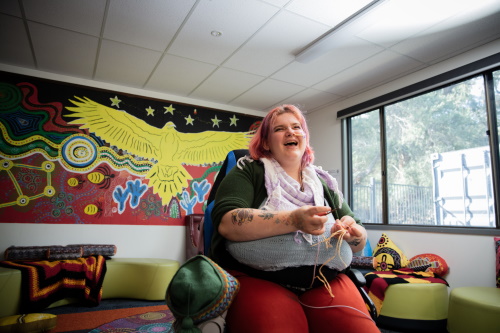
Fay is a proud Palawa person, and creativity has been both a constant passion and a way they connect to culture.
“I enjoy crafting things,” Fay says. “I started knitting when I was about eight years old. My grandmother taught me. Later, I picked up crochet and then learned to weave using the loom and raffia.”
They continue, “Weaving is very cultural for me. It grounds me in my body and helps me connect to my history and the people who came before me.
Fay lives with Functional Neurological Disorder (FND), Autism and DeafBlindness. As a DeafBlind person, their preferred language is Auslan. They use hearing aids and a screen reader, but without an interpreter, it can be harder for them to access information.
This makes advocating for accessibility something they are very passionate about. They are on the accessibility advisory board for Our Survival Day (OSD) and the Koorie Youth Council. It’s through these spaces that Fay has built a sense of community.
“Community is in every part of my life.” They say. “Within our culture, we focus on our elders and our stories and having access to support in a way that understands culture, identity, and how they intersect is so important.”
“My queer identity is a large part of my life. The way I view gender is much more aligned with my Aboriginal identity than it is with any other concepts of gender.”
In Fay’s experience, resources like the Disability Gateway are an essential way to connect to support that is culturally appropriate and considers all parts of who we are and what we may need.
“There’s so much value in the places where we can come together, talk to each other, go to events and connect. Those are the things that really fill my cup.” Fay says.
You can also look at...
| Audio | Visual |
|---|---|
| [Background music playing - soft piano] | A person is weaving using raffia. |
CC I can feel the connection throughout in my body and it strengthens my sense of identity. | A person is sitting in a wheelchair in a garden at a community gathering space. They are signing in Auslan to the camera. |
| [Background music playing - soft piano] | A person is moving through the garden in a wheelchair. They are holding a cane. |
| CC My name is Fay Mason, I am 20. And I’m passionate about knitting, crocheting. And also being very creative. | Fay is sitting in a wheelchair in a garden at a community gathering space. They are signing in Auslan to the camera. |
| [Background music playing - soft piano] | Fay is sitting in a wheelchair in the community gathering space. They are weaving using raffia |
CC So for me, for example, I’m a DeafBlind person, which is a little bit different to people who are deaf. I can’t actually see any of the online video resources. I do have hearing aids, and I do wear them. And also, I have a screen reader. So I can utilise those devices and retain some access, but it’s not perfect. And it’s also not easy. So if it’s face to face, for example, that’s a lot easier for me, but only if there’s an interpreter there to provide the access for me in my preferred language. And if there’s no interpreter there, then I can’t access any of the information. | Fay is sitting in a wheelchair in a garden at a community gathering space. They are signing in Auslan to the camera. |
| [Background music playing - soft piano] | Fay Fay is sitting in a wheelchair in a room at a community gathering space. They are signing in Auslan with an Auslan interpreter. Fay and the Auslan interpreter are browsing the Disability Gateway website on a laptop. |
CC My favourite thing about these First Peoples is that they are culturally encouraging, they’re open. They’re welcoming and they’re inclusive. And in terms of access, they do try their best at providing access. | Fay is sitting in a wheelchair in a garden at a community gathering space. They are signing in Auslan to the camera |
| [Background music playing - soft piano] | Fay is sitting in a wheelchair in a garden at a community gathering space. They are smiling. |
CC It creates cultural safety for me. And that means you’re not on this earth alone. You have everybody else surrounding you and supporting you. | Fay is sitting in a wheelchair in a garden at a community gathering space. They are signing in Auslan to the camera. |
| [Background music playing - soft piano] | Fay is smiling while looking off camera. |
| [Background music fades out - soft piano] | A closing slide appears with the Disability Gateway logo, the Australian Government logo and the website URL: www.disabilitygateway.gov.au |
The importance of culturally safe support: Fay’s story
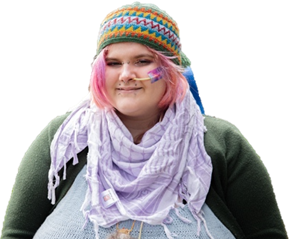 | This is a story about Fay. Fay is a proud Palawa person. |
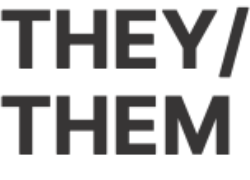 | Fay uses they/them pronouns. They are a person with a disability. |
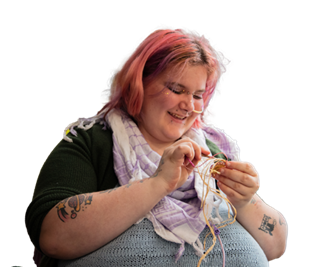 | Fay loves to crochet, knit and weave. Weaving helps them to feel connected to their culture. |
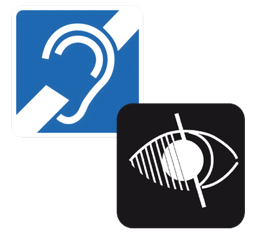 | Fay is Deafblind. The language they use is Auslan. |
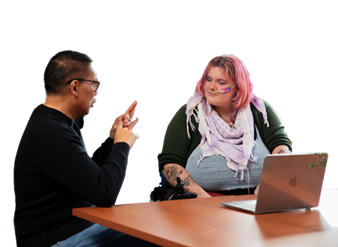 | They sign Auslan with an interpreter. They also use hearing aids or a screen reader to get information. |
 | They say it is important for everyone to have access to the information they need. |
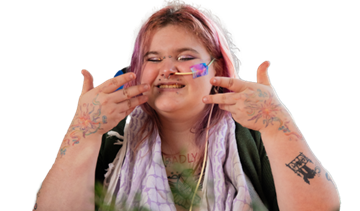 | Connecting with their community makes Fay feel very happy. |
 | They say the Disability Gateway can help you find support that understands your culture and your community. |